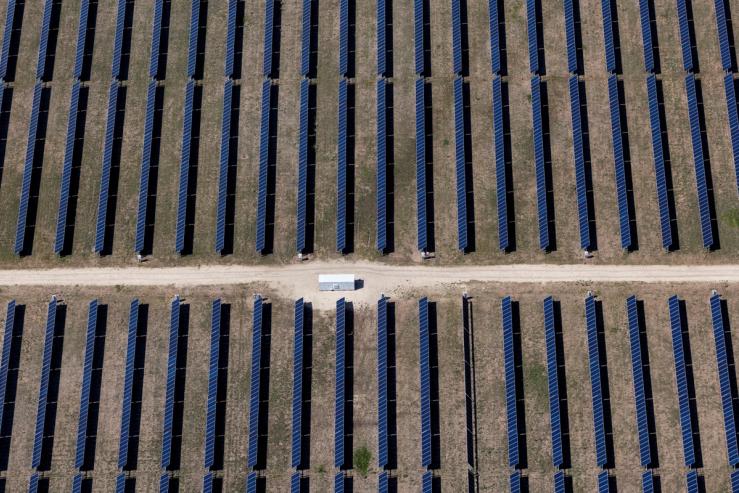
Some of the largest renewable energy investors are still bullish about the US market despite antagonism from the Trump administration.
Private equity giant Brookfield on Wednesday spent $6.5 billion, alongside Caisse de Depot et Placement du Quebec, to acquire the Canadian renewable energy company Boralex, which has a 4-gigawatt pipeline of projects under development globally, including many in the US.
Meanwhile, Sandhya Ganapathy, CEO of EDP Renewables North America, told Semafor at CERAWeek that the company plans to increase the US share of its global capex from 45% to 60% in the next few years, representing $5 billion in new project investments. Much of that is driven by data centers. “I’ve been doing this for more than 15 years, and I’ve never seen demand this good,” she said. “It’s a fantastic time to be on the generation side in spite of all of the policy challenges and the backlash that we have.”
The biggest obstacles now, she said, are slow permitting and an underdeveloped grid. That view was shared in a separate interview with Andrew Flanagan, CEO of RWE Americas, which said last week it will plow $20 billion into new renewables and gas projects in the US. “The US is still a great market,” Flanagan told Semafor. “We take a long-term view, and we can’t overreact to the short-term variability in policy.”
More from Semafor Energy
- Data centers’ new strategy to reduce power crunch
- Oil prices rise as Trump’s Iran extension fails to calm markets
- India’s delayed climate plan sets modest emission target
- Repair costs for Gulf fossil fuel infrastructure could hit $25B
- Oil prices surge again over dwindling optimism of ceasefire
Data centers’ new strategy to reduce power crunch
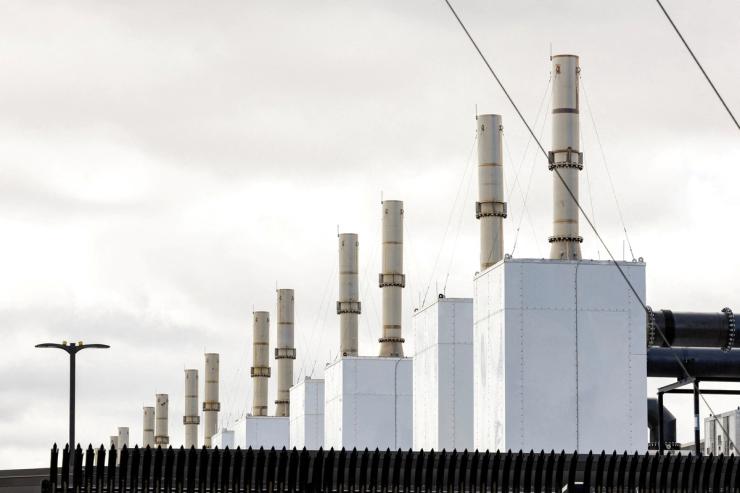
Electric utilities and tech companies are embracing a different solution to the data center power crunch: Ramping down their consumption at times of high demand.
When tech CEOs visited the White House to commit to steps to limit the impact of their data centers on retail power prices, they were mainly focused on generation, that is building their own new power plants so as not to take too much from the grid. But for myriad bureaucratic, supply chain, and technical reasons, that approach will always be insufficient, Arshad Mansoor, CEO of the industry-funded research group EPRI, told Semafor. Instead, large-load demand flexibility, in which data centers agree to periodically curb their consumption in exchange for cash or for express access to the grid, “will be the biggest thing to happen on the grid in the next five years,” Mansoor said.
This week, EPRI released a methodology utilities and hyperscalers can follow to make this happen, which drew support from the likes of Nvidia, Meta, Duke Energy, and Southern Company. “We’re not fully utilizing the existing system,” David Dardis, chief external affairs and growth officer for the power company Constellation, told the CERAWeek conference. “In the AI race with China, if we wait around for new baseload [generation] to come on the system, that’s going to take 10 years and it’ll be too late.”
Oil prices rise as Trump’s Iran extension fails to calm markets
Oil prices hit $110 a barrel after US President Donald Trump’s decision to postpone strikes on Iran’s energy plants failed to alleviate fears of a protracted conflict. US Secretary of State Marco Rubio will discuss conflict de-escalation at a G7 meeting in France today. At the same time, The Wall Street Journal reports that the Pentagon is weighing sending up to 10,000 troops to the region.
The Macquarie Group warned that oil may hit a record $200 barrel if the war drags on until June — a scenario that officials in Saudi Arabia and the White House are reportedly looking into. Meanwhile, a JPMorgan analysis found the world is now moving from a problem centered on a shock to energy flows to one of stock depletion, which is likely to turn into supply scarcity for much of the world. March saw one of the largest drawdowns on global oil inventories on record.
The last cargo ships that left the Gulf before the war started have nearly all reached their destination in Asia, which is likely to face the first visible demand losses in April, according to JPMorgan. Africa will be next, and then Europe. The US, with longer voyage times and substantial domestic production, will initially experience a price shock, but in California, the most exposed region, this could evolve into a supply challenge by late April and May.
India’s delayed climate plan sets modest emission target
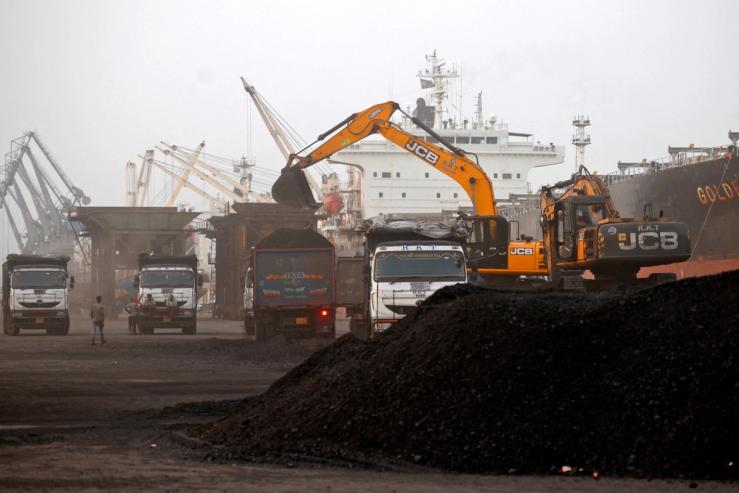
India’s much-delayed 2035 climate plan underestimates the country’s clean energy potential and allows for an acceleration of emissions growth, according to analysts. The plan aims to reduce the emissions intensity of its GDP by 47% from 2005 levels and increase the share of its electricity capacity from nonfossil sources to 60% by 2035.
The reduced carbon intensity target would, however, still allow India’s carbon emissions to increase by 70% over the next decade if GDP grows at a target rate of 7% per year, Lauri Myllyvirta of the Centre for Research on Energy and Clean Air told Semafor. That would translate to emissions growth of 5.5% per year, above the average rate of 3.5% over the past decade.
India is also on track to achieve its clean power capacity target well ahead of time: Its Central Electricity Authority projects that nearly 70% of power capacity will come from nonfossil sources by 2035-36.
“India’s booming clean energy industry is highly likely to deliver much faster progress than policymakers were prepared to commit to,” Myllyvirta said. Disruptions to oil and gas flows caused by the Iran war and the competitiveness of clean energy could strengthen the case for accelerating renewable deployment.
Repair costs for Gulf fossil fuel infrastructure could hit $25B
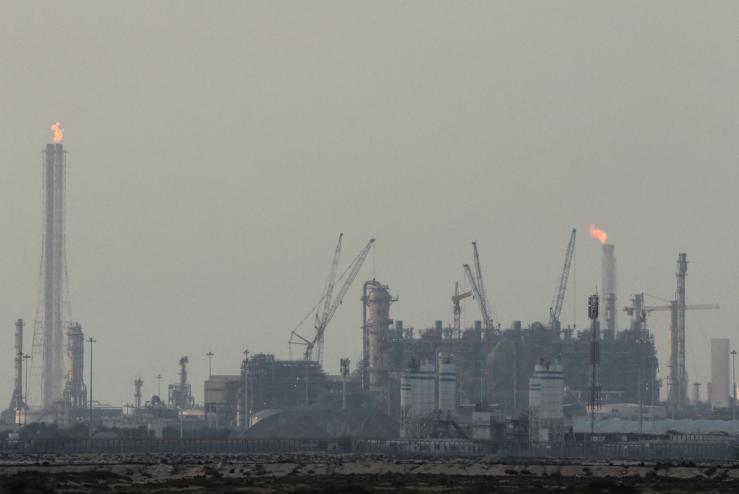
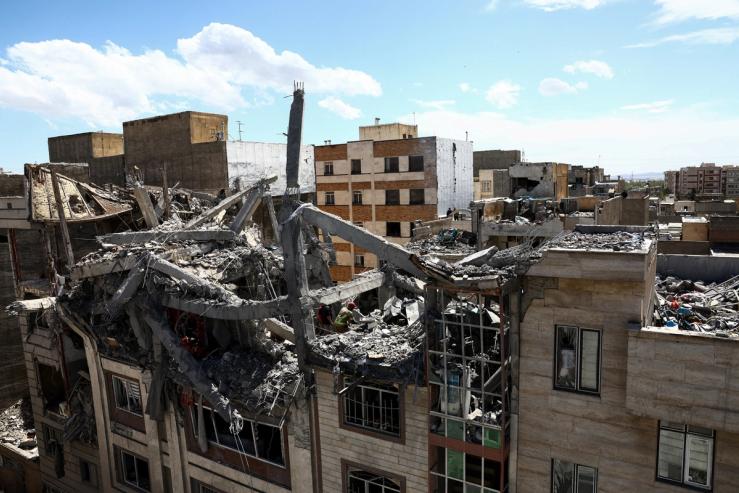
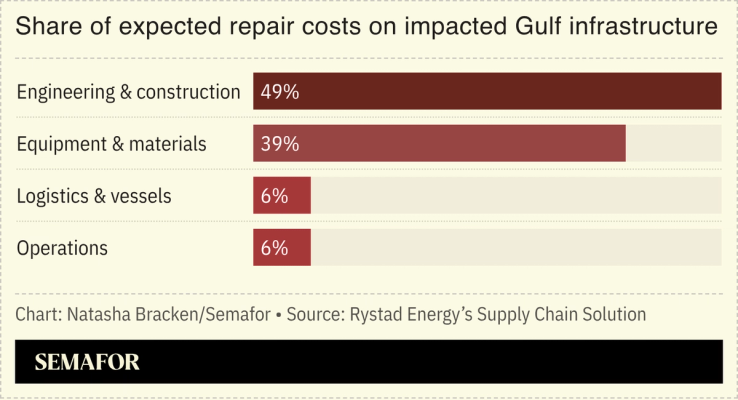
Repair costs from reported damage and shutdowns hitting fossil fuel infrastructure in the Middle East could amount to at least $25 billion.
Rystad Energy expects the bill for restoring LNG trains, refineries, fuel terminals, and key gas-to-liquids facilities to climb even further, largely driven by engineering and construction costs, and to a lesser extent by equipment and materials. The costliest attack hit Qatar’s Ras Laffan Industrial City, where the destruction of LNG trains has reduced capacity by 17%, and full recovery will likely take five years, as the gas turbines needed to power LNG main refrigeration compressors were already in high demand for data center electrification and coal plant retirements.
“The Gulf region’s recovery will be defined less by financial capital and more by structural constraints,” said Audun Martinsen, the head of supply chain research at Rystad Energy. “While some assets may be restored within months, others could remain offline for years.”
Oil prices surge again over dwindling optimism of ceasefire
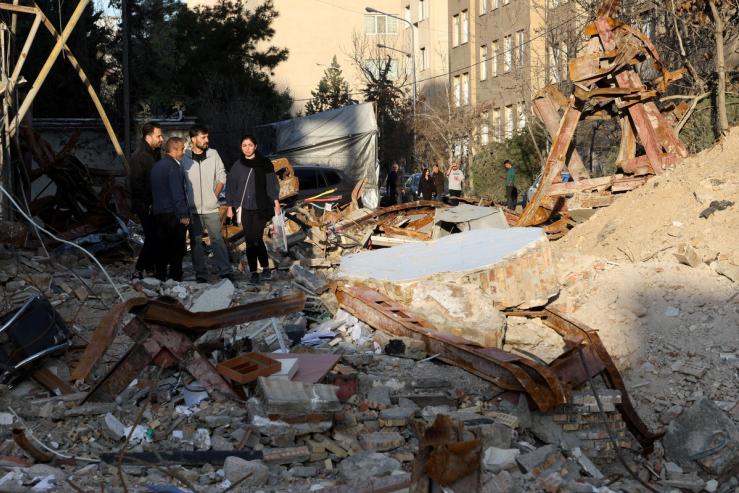
Oil prices swung back above $105 a barrel amid signs of protracted disruptions to global energy flows and dwindling optimism of a ceasefire. Tehran dismissed the 15-point US proposal to pause the war and issued its own counterproposal. The economic fallout from the conflict is biting, with fuel shortages spreading worldwide and companies grappling with the consequences of rising prices and disrupted supply chains.
Analysts have revised down the global LNG outlook for this year. Iraq’s oil production has plummeted as the country is unable to export crude through the Strait of Hormuz and storage levels are reaching capacity. Meanwhile, Reuters estimates that at least 40% of Russia’s oil export capacity is at a halt following Ukrainian attacks on energy infrastructure and the seizure of tankers. The Trump administration is looking at what the fallout for the economy could be if oil prices spiked as high as $200 a barrel, according to Bloomberg, though the White House has denied it is doing so.